
Introduction
What the Partner API does, how to authenticate, and where to go first.
Connectivity inside your product, under your brand
- Users
- Lines & eSIMs
- Port-ins
- Suspend & restore
- Usage & analytics
- Data pools
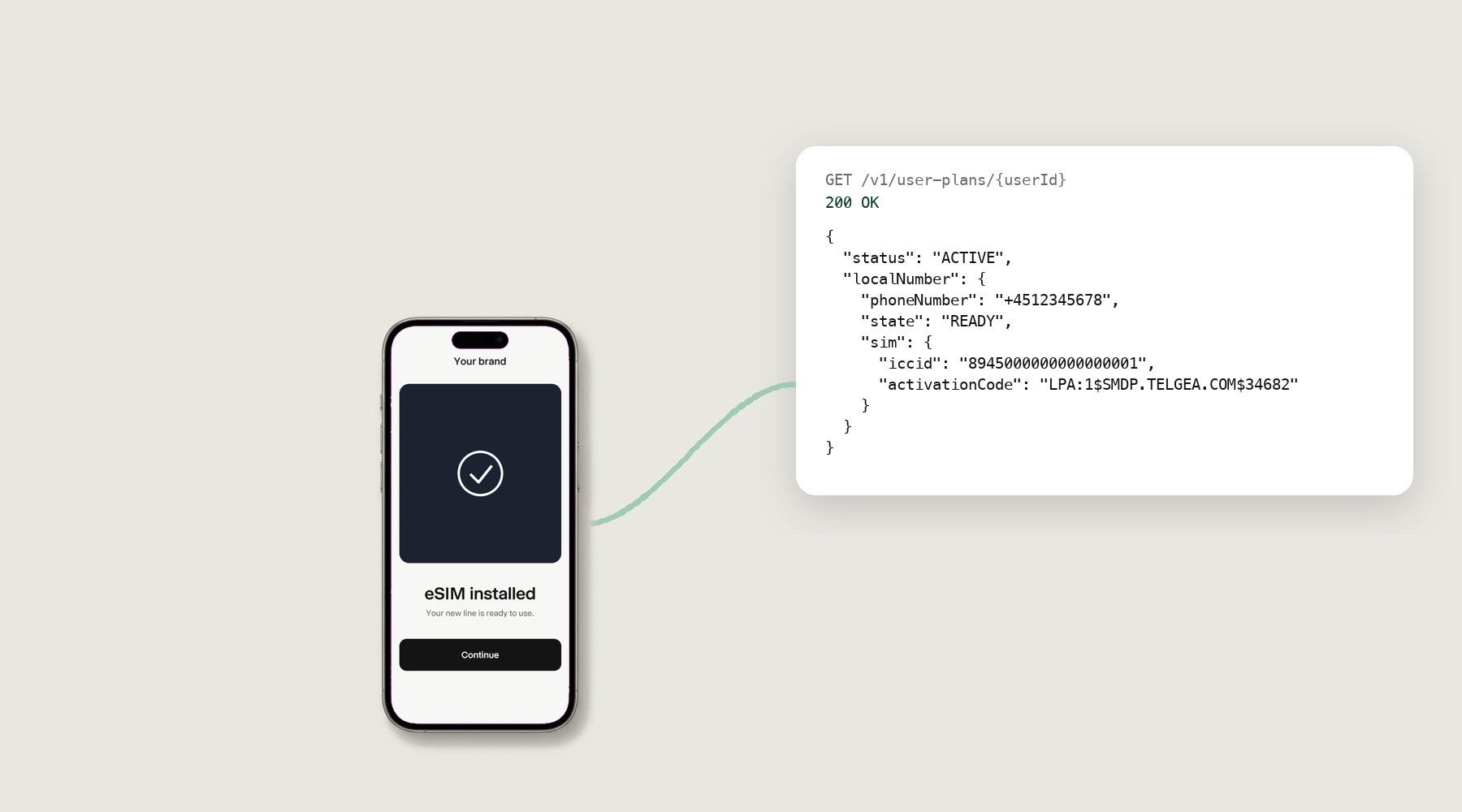
The Partner API lets you run connectivity for your own customers under your own brand: create end-users, obtain lines and eSIMs, port numbers in, stop and restore service, and read usage to bill on. Telgea sends your customers nothing: you render the QR code and you send the messages. The network under each line is not white-labelled, though: phones display its name, and in some markets it texts customers about their data or roaming. What the network shows your customers lists both per market.
Requests are authenticated with your API key; see Authentication for how you receive it and what to do if it leaks.
Make your first call in the playground
The playground lists every operation with a working example request. Paste your API key, pick List users and send it: it is a read, so it changes nothing.
There is no sandbox
Calls from the playground run against your own live organization, with your own key. Creating a user creates a real user, and provisioning creates a real line.
Base URL
All requests go to https://api.telgea.com; every operation is under /v1.
Start here
Try it in the playground
Send a real request from the browser with your own key, before writing any code.
Provision a line
Create a user, obtain a line and its eSIM, and deliver the activation code.
Port a number in
Discover the fields each country needs, validate, submit and track the port.
Stop and restore service
Stop a customer's mobile data, or suspend a lost phone's number, and restore either.
API reference
Every resource and operation, with the permission each one needs.
Resources at a glance
| Resource | Purpose |
|---|---|
| Users | The people who hold a line |
| Teams | Groupings for billing, access and reporting (Enterprise API only) |
| Numbers (Partner API) / User plans (Enterprise API) | Lines and eSIMs: obtain one, replace a SIM, stop and restore service, and end a line |
| Port-ins | Numbers arriving from other carriers |
| Usage | Raw call, SMS and data records to bill on |
| Analytics | Consumption aggregated per interval |
| Data pools | The shared data your numbers draw on |